alleleFinder
Inherited variants that a cancer database had mislabelled as tumour mutations, and the ancestry gap in that error.
Wilkerson Lab (USU) and NCI Cancer Data Science Lab · 2021 to 2024
The problem
Cancer genomics rests on telling two kinds of variant apart. A somatic variant is one the tumour acquired. A germline variant is one the person was born with, carried in every cell, often shared with many healthy people. Treatment decisions, mutation burden estimates and gene discovery all assume a database of cancer-associated somatic variants contains somatic variants.
Some of them do not. Ordinary inherited variation, common enough to appear in healthy population databases, had been recorded as cancer-associated.
What I did
I compared a large healthy-population variant resource, gnomAD, against a curated cancer mutation database, COSMIC, and looked for entries that appear in the cancer database while also occurring in healthy people at frequencies too high to be plausible somatic mutations.
Doing that honestly is mostly an exercise in making two large datasets actually comparable. The two resources were built on different reference genome builds, so coordinates had to be lifted from GRCh37 to GRCh38 before anything could be matched, and a variant can be written more than one way at the same position. The comparison itself runs over millions of variants, which is why the pipeline is built on Hail and Spark rather than on a laptop.
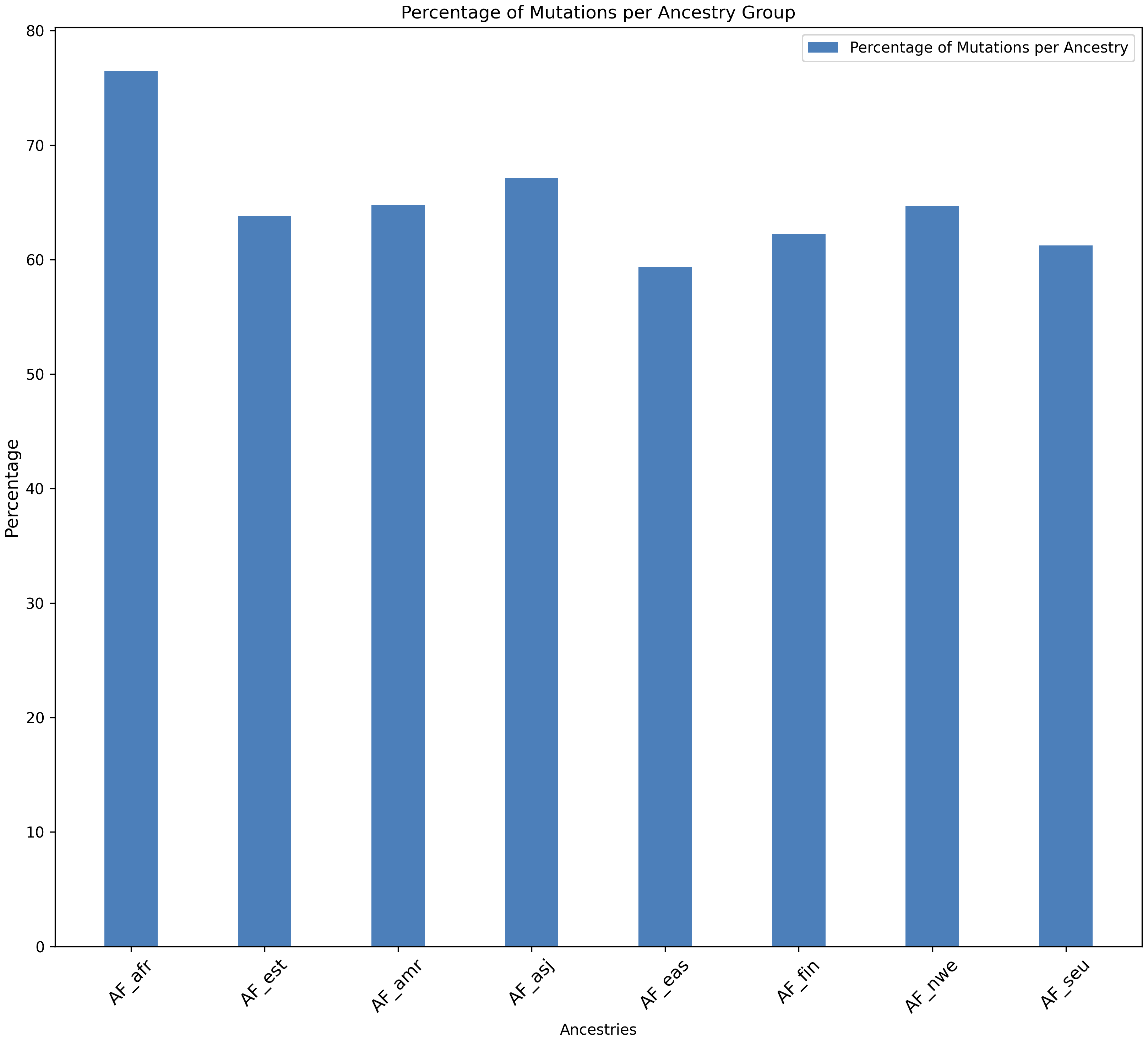
I then broke the results down across the eight ancestry groups gnomAD reports, to ask whether the problem is evenly distributed. It is not.
Why the ancestry breakdown matters
A variant is only recognisable as ordinary inherited variation if the population reference contains enough people who look like the patient. Population databases have historically been built disproportionately from people of European ancestry. So the filter that is supposed to catch germline variants before they are called somatic works least well for the people it is least trained on.
The consequence is not abstract. It means the quality of a cancer variant call depends in part on the patient's ancestry, and it means bias introduced at the reference-database stage propagates quietly into every downstream analysis that trusts the database.
Where it went
The work began in 2021 at the Wilkerson Lab, was presented as a poster in 2023, and was published in Frontiers in Medicine in 2024 with Matthew Wilkerson and Padma Sheila Rajagopal.
Stack
Python, Hail and Spark on Google Cloud Platform for the variant-scale processing, with R and Python for the statistics and figures. Reference build liftover between GRCh37 and GRCh38.
The underlying COSMIC data cannot be redistributed under its licence, so only aggregate figures appear here and no merged variant tables are published.