Bio and MLData
Predicting propensity to vote
A machine-learning study of voter turnout. arXiv preprint.
Independent · 2021
What it is
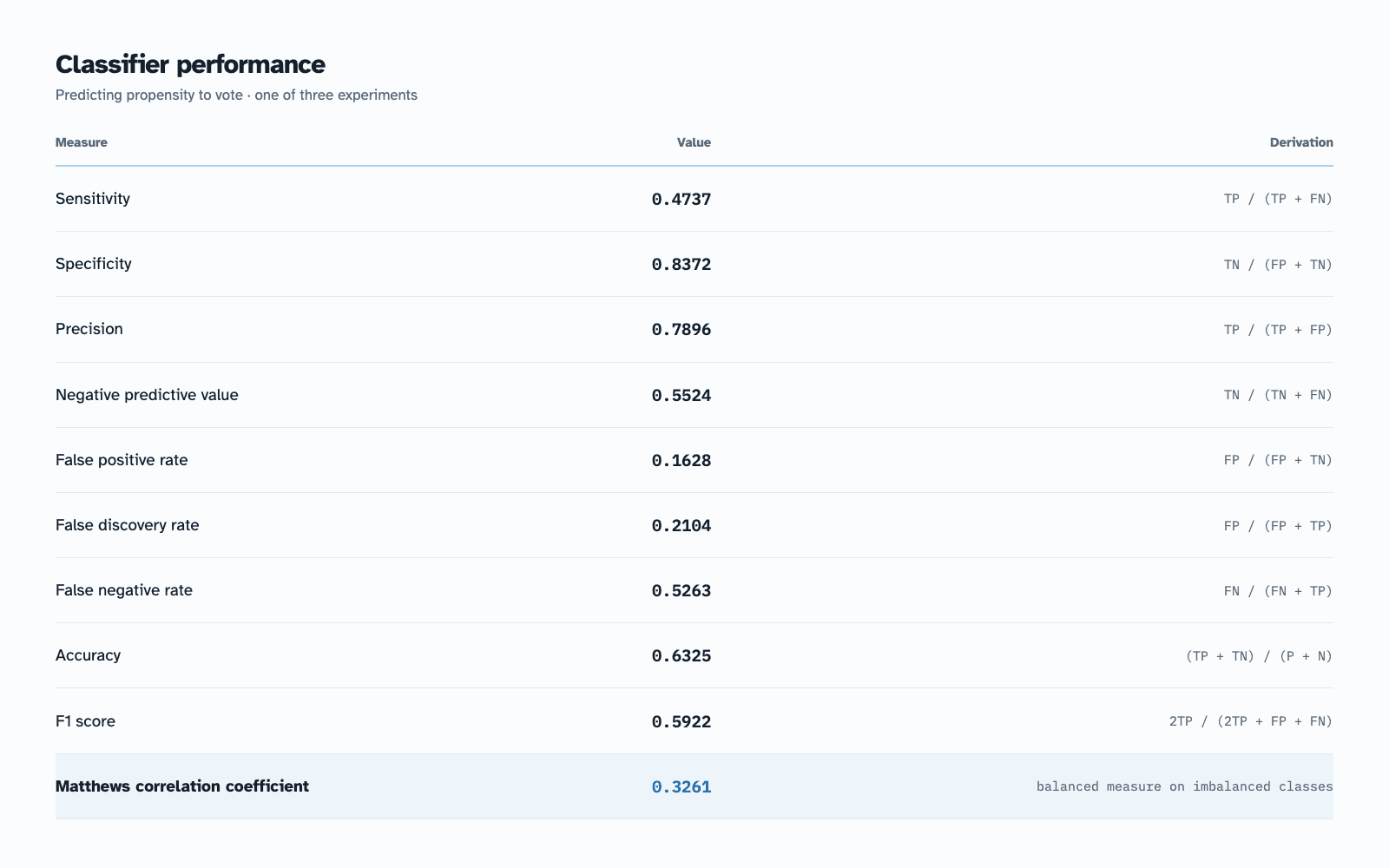
An early project, and my first piece of published writing. We trained supervised models to predict whether an individual would turn out to vote, and reported the result using the Matthews correlation coefficient rather than accuracy, because turnout data is imbalanced enough that accuracy flatters a model that has learned very little.
0.39
Matthews correlation coefficient, best of three experiments
3
Experiments run on voting data from 2004 to 2018
2021
Posted as arXiv preprint 2102.01535